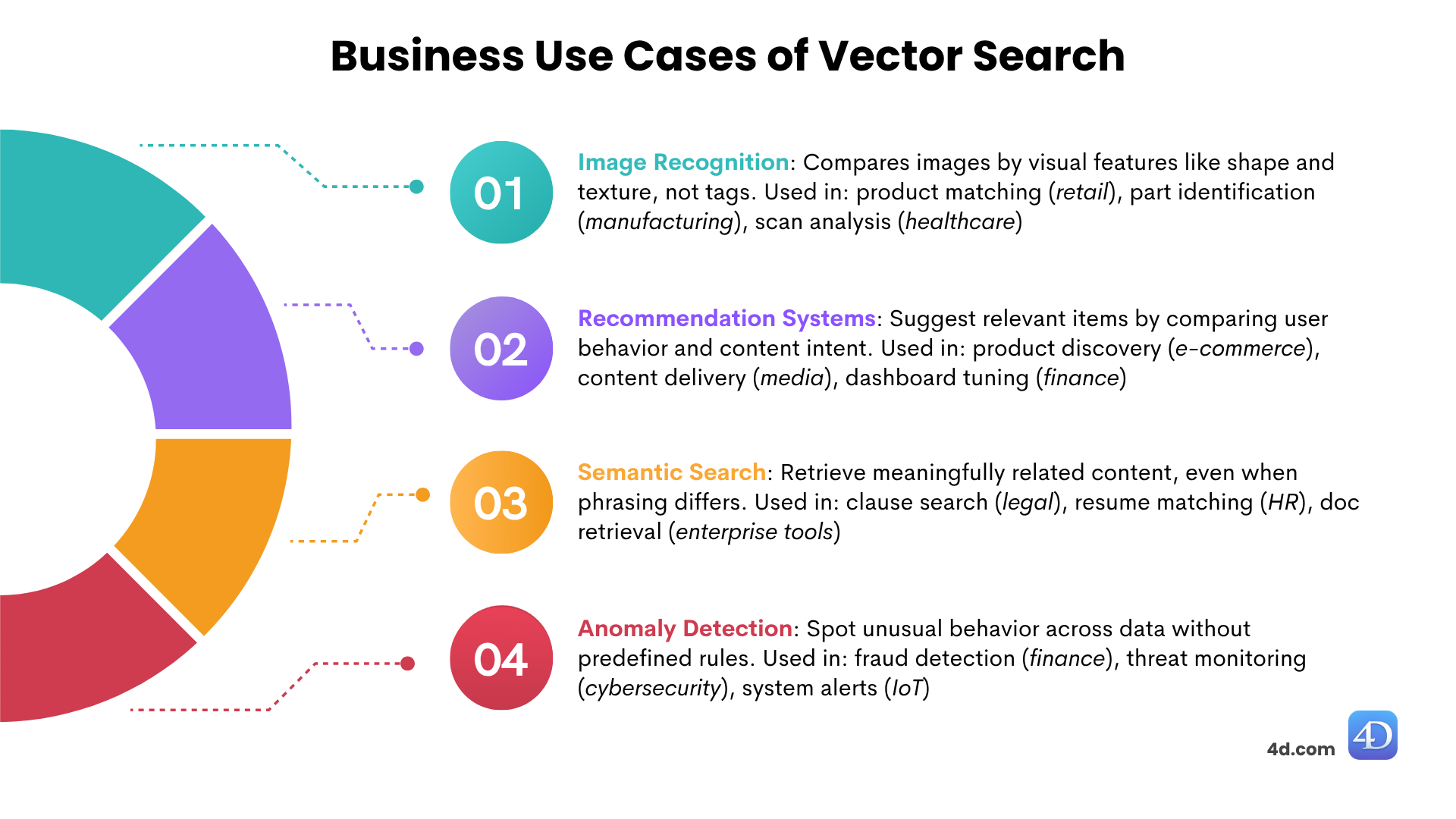
Why Your Search Stack Feels Broken — and How Vector Search Fixes It
You ask a question. Your system gives you keyword matches — close, but not the answer. The real insight? It’s buried in a doc, phrased differently, or...
You’ve built the app. Now you need to ship it — fast, clean, and licensed. With 4D 20 R10, you can automatically embed your deployment license into yo...
4D 20 R8 introduced the TCPConnection class, bringing an object-oriented, asynchronous way to handle TCP client connections. Then came 4D 20 R9 with t...
Working with calendar events is a core part of many business applications. Whether you're organizing a team meeting or managing an event’s life cycle,...
Following the launch of the Follow 4D version rule, we’re excited to introduce a new level of automation and reliability in 4D 20 R10: fully recursive...
With 4D 20 R10, object typing takes a major step forward, giving you more confidence and control in your code. Instead of simply checking if a value i...
ORDA is a core long-term feature that opens up a world of new possibilities in 4D. We keep enhancing ORDA to help you write powerful code. As a resul...
You work across environments — test, production, staging — and you copy more than text. Sometimes it’s formulas. Sometimes it’s data that shouldn’t mo...
The 4D language supports the concept of classes and thus, the concept of constructor. On the another hand, the ORDA abstraction layer, through Data M...
In application development, it is often necessary to build forms dynamically. For example, you might want to generate a search form on the fly, tailor...
Got a question, suggestion or just want to get in touch with the 4D bloggers? Drop us a line!
* Your privacy is very important to us. Please click here to view our Policy