
Moving Forward: Say Goodbye to Legacy Network Layer
At 4D, our mission is to provide you with the most robust and modern tools for your applications. To do that, we sometimes have to let go of the past ...

April 29, 2026
1 min read
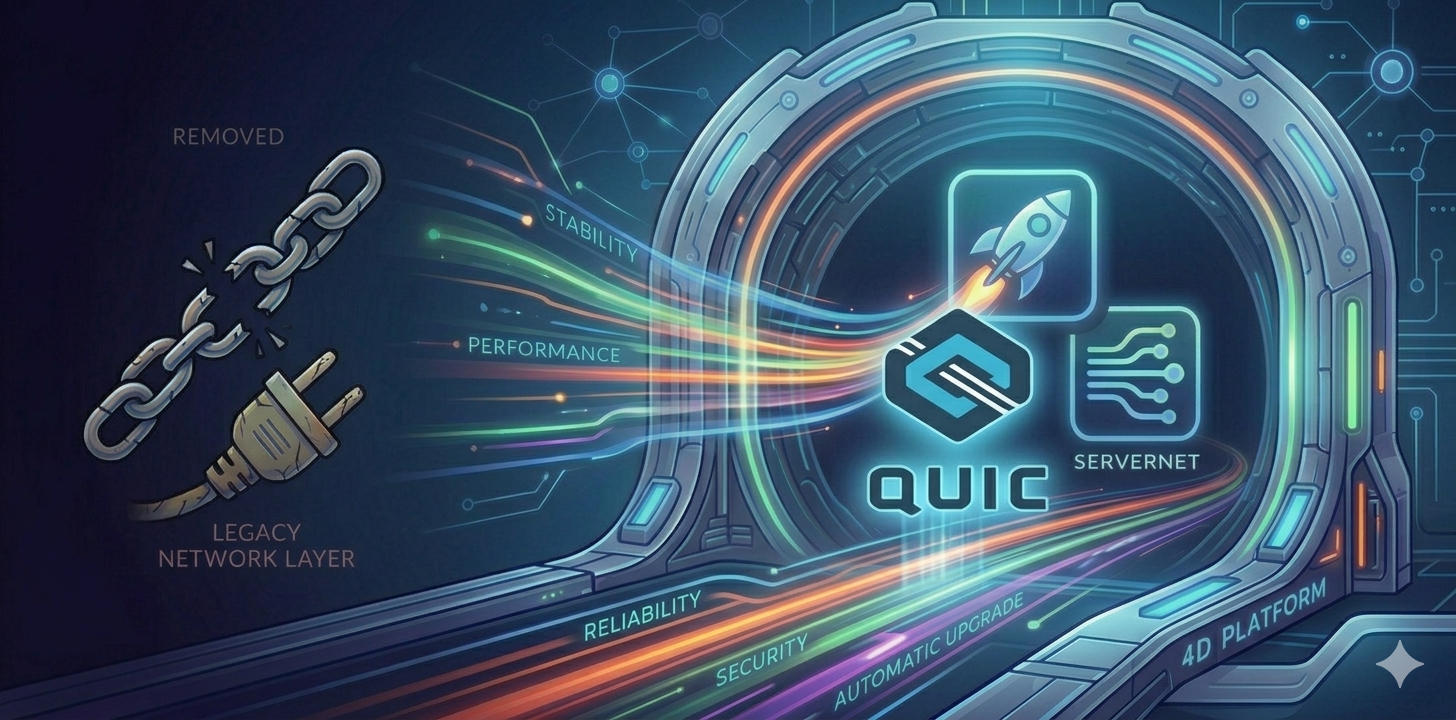
At 4D, our mission is to provide you with the most robust and modern tools for your applications. To do that, we sometimes have to let go of the past ...

What’s more frustrating than losing your 4D Remote connection to the 4D Server while switching networks on the go? Whether you're moving from Etherne...

4D 20 R8 introduced the TCPConnection class, bringing an object-oriented, asynchronous way to handle TCP client connections. Then came 4D 20 R9 with t...

In 4D 20 R8, we introduced the TCPConnection class, allowing you to initiate TCP connections to remote servers. With 4D v20 R9, we're excited to bring...


With the release of 4D 20 R8, a game-changing feature has arrived:: the TCPConnection class. This modern class leverages object-oriented syntax and su...

In recent releases, 4D’s security capabilities have been significantly expanded, particularly in the area of certificates. This includes auto-generate...
To handle the communication between 4D Client and 4D Server, 4D proposes 3 different network layers: Legacy, ServerNet, and QUIC. The Legac...

Our development of the QUIC network layer continues, and with 4D 20 R4, we now have the sleep mode and the automatic update. Let's take a closer look ...
To simplify the security of client-server communications, from 4D v20 R4 onwards, 4D Server generates its own SSL/TLS certificates instead of relying ...

In 4D v20 beta, we were excited to show you our work on the new QUIC network layer. As the layer is still in the beta version, we deactivated it for t...
Got a question, suggestion or just want to get in touch with the 4D bloggers? Drop us a line!
* Your privacy is very important to us. Please click here to view our Policy