
Managing 4D Indexes Programmatically with getIndexes()

October 19, 2026
2 min read
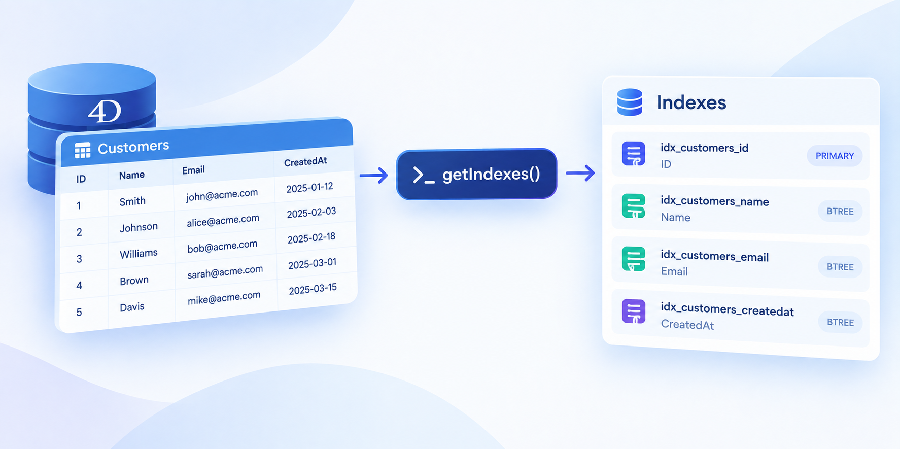
Keeping track of which indexes exist on a table and how they are configured used to require manual inspection through the Structure Editor. With the new getIndexes() function, 4D developers can now introspect indexes directly from code, making it easy to verify configuration at runtime, build diagnostics tools, or validate deployments automatically.
4D adds a new function to introspect indexes directly from code:
var $indexes := ds.MyTable.getIndexes()Calling getIndexes() on a table returns a collection describing every index defined on that table, whether it was created through the Structure Editor or via code with CREATE INDEX.
Each entry in the returned collection describes an index with the following attributes:
| Attribute | Type | Description |
|---|---|---|
type |
integer | Index algorithm type (relevant when “Automatic” is selected) |
automatic |
boolean | True if the “Automatic” index is selected |
name |
text | Index name, if available |
kind |
text | "keywords" or "regular" |
attributes |
collection | Fields covered by the index |
UUID |
text | Unique identifier of the index |
uniqueKey |
boolean | Whether the index enforces uniqueness |
This makes it possible to verify the status of a field’s index at runtime, which is particularly useful for diagnostics and automated deployment scripts.
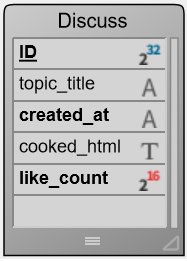
var $indexes:=ds.Discuss.getIndexes()
Before getIndexes(), confirming that a critical index existed or that it was configured with the right algorithm meant opening the Structure Editor and checking manually. That doesn’t scale for automated workflows. With this function, you can:
getIndexes() closes a gap in 4D’s index management API: developers no longer need to rely on the user interface to know what indexes exist on a table. Combined with CREATE INDEX, SET INDEX, and DELETE INDEX, it completes a fully programmatic workflow for managing indexes.
Got a question, suggestion or just want to get in touch with the 4D bloggers? Drop us a line!
* Your privacy is very important to us. Please click here to view our Policy
Comments are not currently available for this post.